The Confessions of a Southern Golden Boy
As published on salvationsouth.com
The Virginia Samford Theater stands on tree-shaded 26th Street South in the Highland Park neighborhood of Birmingham on the same spot where it opened in 1927.
Originally known as the Birmingham Little Theater, the 312-seat playhouse was inspired by the Little Theater Movement of the early twentieth century. The movement encouraged the establishment of smaller, nonprofit theaters around the nation that could highlight innovative new plays—outside the constraints of larger, commercial theaters, which avoided controversial political themes.
Birmingham-born actor and playwright Mason McCulley walked onto the Samford stage one evening last fall for a performance that was much in keeping with the spirit of the Little Theater Movement. He was there to premiere his one-man show, Carole Cook Died for My Sins, the story of a Southern gay man’s triumphs and tribulations as he seeks fame in Hollywood, only to return home twenty years later to be near his ailing mother.
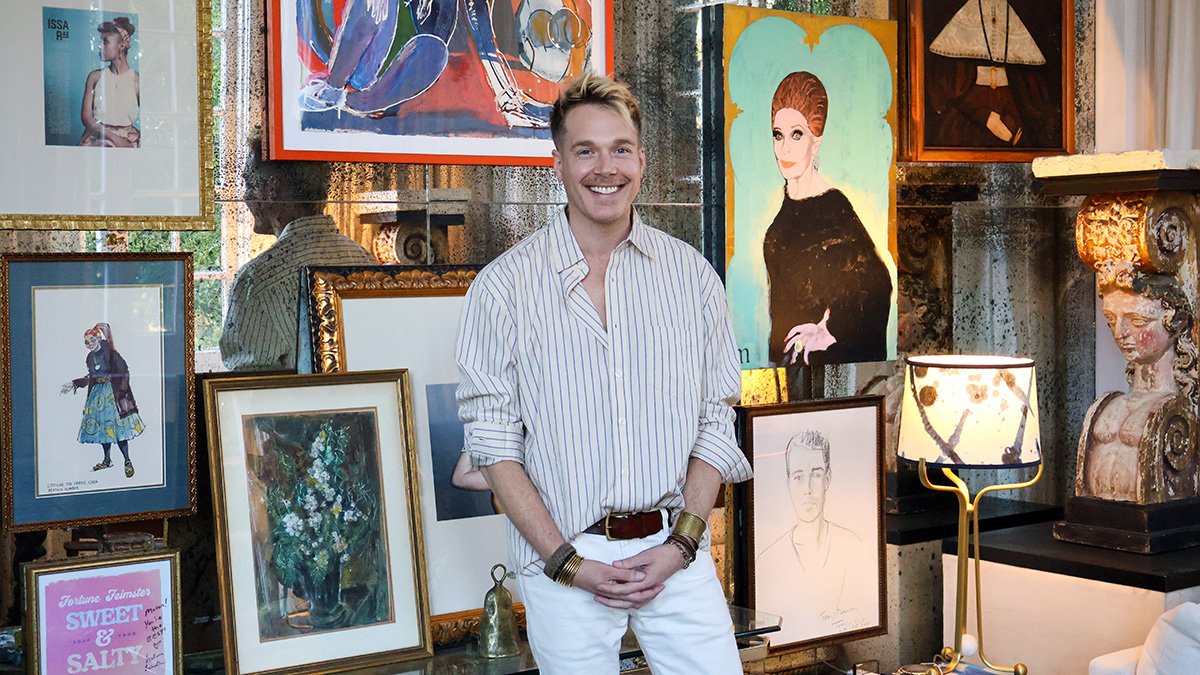
McCulley walked that night onto a stage designed to mimic his Birmingham condominium, where art covers every inch of every wall. As the house lights dimmed, the spotlight illuminated a tall man with an impish air, a persistent twinkle in his eye, and a captivating presence. That night, he performed what he calls an unapologetically “gay story,” which is also, he insists, a resurrection story. Carole Cook Died for My Sins is McCulley’s confession—his years of heavy drinking and sexual adventures—and his grieving. The audience watched him work through unresolved heartbreak about his mother’s slow decline. And they watched him lament his mentor, the titular Carole Cook—an actress, diva, and icon of Old Hollywood who mentored him during the last years of her career.
As McCulley mesmerized the audience packed with patrons, friends, and family members, not everyone appreciated his truth. Offended by his raw honesty and his willingness to stand emotionally naked on the stage, several longtime patrons walked out halfway through the performance.
The Birmingham Little Theater might have been established ninety-nine years ago to push the boundaries of the dramatic arts, but these days, the Virginia Samford Theater is more family-oriented. It typically produces contemporary classics like Our Town or To Kill a Mockingbird, and its mission, highlighted on its website, seeks to bring together “a wide range of the community’s residents to enjoy thought-provoking new performances and soul-stirring classics.” The extensive donor list on the back of any play’s program is a who’s who list of some of Birmingham’s wealthiest families, and season ticket holders are often from the “over-the-mountain” conservative suburbs like Mountain Brook, where McCulley grew up.
In an email to the theater the following week, one season ticket holder who walked out insisted she wasn’t naïve or homophobic, but wrote that she left because the play “was too graphic on the gay sex” and she resented the “in-your-face aspect” of the performance.
Her response didn’t surprise McCulley, who’d been apprehensive about the audience’s reception, even though it was filled with many of the same family and friends who supported him as a teenager acting in high school plays and as an aspiring actor making his way in Hollywood. He understood the risk he took by performing Carole Cook Died for My Sins for the Birmingham audience.
“If there wasn’t a risk,” he tells me, “it would be a Hallmark card.”
McCulley knew his graphic confessions—all of them true—would challenge playgoers, even those who knew him. But he wanted the work to start a conversation about identity and acceptance.
“I wanted to give the audience a safe place to ask uncomfortable questions,” he says.
But some patrons were not comfortable with uncomfortable questions. The playgoer who emailed theater management ended her message by suggesting McCulley stick to “entertainment for the majority.”
An Apartment Built of Altars
The walls of McCulley’s condominium, like the set of Carole Cook Died for My Sins, are covered in artwork. Oil paintings of family matriarchs and patriarchs—the grandfather who aspired to be an actor but became a surgeon—hang alongside a campy rendering of an effeminate Jesus wearing red lipstick. Everywhere you turn is a visual autobiography of McCulley’s life. Paintings, statues, and mirrors create layered vignettes reflecting his history, whether it’s the vintage illustrations from his grandfather’s German anatomy book or the huge advertisement for the magician “The Great Nicola” above his bed—chosen in homage to a girl of the same name he dated in his early days in Los Angeles. Antique birdcages, their doors left open, represent his free spirit. McCulley’s living space displays his humor, his obsession with religious iconography, and his spiritual journey.
Designer Danielle Ballanis helped McCulley create this whimsical mix of styles, which set the stage for his story. The fanciful and vibrant interior design even caught the eye The New York Times interior-design writer Tim McKeough, who featured the space in his piece, “In Tough Times in Alabama, It Helped to Live in a Ballroom.”
A large mural painted on muslin by his friend Krista Machovina features flamboyant peacocks and elegant herons. The colorful peacocks symbolize the late Carole Cook, and the unassuming herons embody McCulley’s beautiful late mother—Sheard McCulley. These two influential women frame his condo’s décor and continue to inspire him daily, even as their absence haunts him.
McCulley’s mother was a socialite, known for her grace, kindness and understated elegance. She loved engaging with everyone she came across and learning their stories. But most of all, she embodied goodness.
“My mom wasn’t walking around talking about Jesus,” he says. “My mom was just a good person, and that was her prayer.”
Sheard McCully was also her son’s biggest champion, when he was on stage and in real life. When he came out at twenty-eight, he was living in Los Angeles and hanging out in West Hollywood, the heart of the city’s nightlife and a nonstop party. His mother likely always knew he was gay, he says, but had been afraid of what that meant for her son. Despite her fears and lack of exposure to queer culture, McCulley says, “My mother was the one who got up to speed with me when I came out as quickly as she possibly could, even though it didn’t fully make sense to her, only because it wasn’t her world.”
Initially uncomfortable about her son’s sexuality and lifestyle, Sheard McCulley shifted her attitude when she took McCulley to talk to a friend in Birmingham—an Episcopal priest who often ministered to the marginalized and was dedicated to building bridges between communities. The Sunday before, the priest had preached a sermon about the appearance of the archangel Gabriel to the Virgin Mary, delivering the news of the upcoming birth of Jesus. Mary, confused, asks what this means, and Gabriel tells her not to try to figure it out or change it. In light of his sermon that day, the priest’s advice to McCulley’s mother about her son was: “Let it be. Let it be what it is supposed to be. Let it be what it’s supposed to become.”
That became the frame for her acceptance of her son.
Sheard McCulley didn’t have to understand someone’s differences to accept his or her choices and identity, and because her first instinct was to protect the more vulnerable, “I think that she truly embodied love,” he says.
Carole Cook entered McCulley’s life long before she would shape his resurrection. He first met Cook when he was only eighteen, when she starred in Hello, Dolly! at Birmingham’s 2001 Summerfest. As a teenager, McCulley had never seen an artist like her, and he was dazzled.
Cook, who played the starring role of Dolly Levi in the 1965 Australian production of the show, was the first to step into Dolly’s shoes after Carol Channing, who originated the role on Broadway in 1964. Cook lacked the fame of Channing or Ethel Merman, who took on the role before the original Broadway run ended, but she was equally brilliant. A Southern diva from Texas, she also felt familiar to McCulley. McCulley remembers her as flamboyant, glamorous, and meticulously composed, a talent who should have had a bigger name but was never bitter about the fact she didn’t.
“People were drawn to her whether they knew who she was or not, and she made everyone feel special,” he says.
The teenaged McCulley was so taken with her star power, after that performance in Birmingham, he waited at the stage door to meet her, where she greeted him wearing a black cape and a black turban, with her husband, actor Tom Troupe, carrying a carpet bag full of makeup—a dramatic exit that stuck permanently in the young man’s mind.
McCulley told Cook he planned to return the next night with his mother, and she encouraged him to come backstage again. He returned four times and became a devoted young fan, tracking Cook’s work and listening to her sing on cast recordings.
Electrified by her “greatness,” he would rekindle his connection seven years later after he’d moved to the West Coast.
Golden Boy With Nowhere to Go
McCulley grew up in Mountain Brook, a quiet, predominantly white suburb. Most families in Mountain Brook had generational wealth, but gay role models didn’t exist.
“From my perspective, being gay was not an option. I did not have an example in my community of what growing up and being gay would look like,” he says. At least a positive one
Born in 1982, he spent his formative years almost entirely defined by catastrophe.
“We were still recovering from AIDS,” he says, “I grew up in the 80s and 90s, and it was all AIDS and death.” McCulley was influenced by The Normal Heart, Larry Kramer’s play about the HIV-AIDS crisis in early-1980s New York, and Jonathan Demme’s 1993 film Philadelphia, which stars Tom Hanks as a lawyer whose firm fires him after he is diagnosed with AIDS. Mainstream culture in the 1990s was inundated with images of funerals and hospital beds. And in the heart of the Bible Belt, in a neighborhood whose people were obsessed with lineage and propriety, being queer was less of an identity and more of a menace. Countless preachers, such as Jerry Falwell, claimed AIDS was a scourge brought upon by sinful, aberrant homosexuals.
But McCulley no longer sees all of Christianity in that light. He sees the current version of evangelicalism in the modern South as a distorted system that’s weaponized the Bible. Instead, McCulley takes the view that the teachings of Jesus are inclusive, rooted in love and affirming queer lives rather than condemning them. If queer culture disrupts and resists societal norms, that means Jesus was “queer” because he was a rebel hanging out with the prostitutes and the poor, he says, with a mischievous grin while sitting on his sofa, a portrait of Marie Laveau, a New Orleans voodoo queen who blended African traditions with Catholicism, hanging behind him.
“Christianity’s biggest fault is it became exclusionary and exclusive, and that’s the exact opposite of what Jesus said,” he says.
McCulley acknowledges that the old-money, insular bubble of Mountain Brook gave him advantages—the means, poise and encouragement to chase a life in the arts. He acted in high school plays and says his family and teachers always celebrated his creativity, which gave him the sophistication and confidence to pursue acting on the West Coast. In almost every way, McCulley “matched” the expectations of a Southern golden boy—except for the one part that didn’t fit. And when he searched for positive role models, he could find none.
After high school, McCulley dreamed of heading to Los Angeles to act in theater and appear on television. He wanted to study theater at Pepperdine University in Malibu. At eighteen, he says, he was “beautifully delusional,” full of confidence he could achieve his dreams.
He knew he had to leave Mountain Brook. Despite the support he received, the Birmingham suburb’s narrow script didn’t have room for an out, gay actor.
“I don’t know what would have happened if I had stayed. It would have been harder,” McCulley says, “a lot harder.”
Hollywood Lights and Shadows
McCulley graduated from Pepperdine in 2005 and immediately landed an agent. He began appearing in guest roles on TV shows—Grey’s Anatomy, CSI: New York, and Castle, among others—as he built his career. The Hollywood scene meant industry events, long dinners, and late nights—an environment where heavy drinking is normalized. McCulley spent a lot of time hanging out in West Hollywood at The Abbey, a longstanding and legendary gay bar and restaurant. The Abbey is the heartbeat of the Los Angeles gay community, known for its crowded patio, strong drinks, elaborate brunches, male go-go dancers, and drag shows that draw a mix of celebrities, locals and tourists. McCulley describes it as a “sacred, messy” place—its decadent dance floor, lights, and smoke machines juxtaposed with crucifixes and stone statues of monks and saints. This irreverent cathedral was Elizabeth Taylor’s favorite spot, and her portrait hangs on the wall with the menu featuring a drink named after her.
Soon after he came out in 2010, McCulley reconnected with Cook through his friendship with Cameron Watson, an L.A.-based actor, screenwriter, director, and fellow Southerner. Originally from Kentucky but raised in Tennessee, Watson had attended the University of Montevallo in Alabama and started his career at the Virginia Samford Theater. Watson asked McCulley to take part in a reading of a screenplay he had written. Carole Cook was reading the starring role that night, and McCulley says it felt like two old friends had found each other again.
Cook, then in her eighties, was dressed in her signature head-to-toe black. Cook said her look was inspired by a moment in Anton Chekhov’s The Seagull. In the play, Medvedev, a schoolteacher on a grand, nineteenth-century estate, asks Masha, the daughter of the estate’s steward, “Why do you always wear black?”
“I am in mourning for my life,” Masha replies.
Cook contrasted the mourning black with big jewelry, bright red lipstick, and red hair she had done every Friday.
“She called her hair the monument, because you couldn’t take it down,” McCulley says with a laugh.
Cook had season tickets at the Ahmanson Theater in downtown L.A., known for its productions of plays from Broadway and London’s West End, and often took McCulley with her. Afterwards he, Cook, her husband, and friends would go to The Abbey, eat cheeseburgers, drink martinis, and talk about the play. They talked endlessly about queer history, Old Hollywood, AIDS, and Cook’s decades of work playing AIDS benefits. Cook and McCulley were mesmerized by each other.
“She saw me, and she knew that I saw her,” McCulley says. “She recognized that I recognized her magic, and she also recognized my magic. It was like we understood each other.”
McCulley called Cook his “fairy godmother.” She attended his birthday parties, watched his TV appearances, and supported his plays. He frequently visited her, where Cook would hold court in her living room, surrounded by Old Hollywood memorabilia, and regale an intimate audience with her stories. Cook quickly became like family.
“She had a lot of opinions about every single boy she met that I dated,” he says, “and she was always right—but I’d never realize she was right until about a year later.” But Cook never confronted McCulley about his drinking.
McCulley’s life was in full swing professionally and socially in 2015. He landed roles on two prestige series on HBO—Insecure and Westworld—and several ad campaigns. But that same year, back home in Mountain Brook, his mother developed early-onset dementia
“It all happened at once and then my mom got sick, and I gave up,” McCulley says. “That’s when the drinking got bad, and I just gave up.”
From Last Drink to First Draft
During the COVID pandemic, McCulley’s drinking escalated and became a more destructive force. Both his mother and Cook, by then in her late nineties and suffering with heart failure, were dying. Living through long goodbyes with both women and life in the pandemic paired to give McCulley “an excuse to drink,” he says. The more his mother’s mind receded and her body failed her, the more he drank and descended into what he calls “his darkness,” a place of fear, panic, emptiness and a longing for his lost mother. Over his final year in Los Angeles, McCulley stayed afloat with acting jobs and cared for Cook and her husband Tom Troupe as they aged.
Then, in 2022, McCulley turned forty and moved back to Birmingham. The last time he saw Cook, in January 2023, she was under hospice care at her home in Beverly Hills, the same memorabilia-filled house where they had celebrated so many times together. The hallway near her bedroom was lined with photographs of her famous friends to remind her of a different era, but the house had grown quiet. Her mind was still sharp, and she tried to maintain her movie-star aura, McCulley says, but she was struggling. He was, too, he remembers, but they were both still performing for each other.
“It wasn’t a goodbye to her. It was a goodbye to me. I knew it was a goodbye. She did not, thank goodness,” he says. When he saw her, he was ten days sober. When Cook announced she wanted a piña colada, McCulley says, “I thought, ‘Well, I’m not missing this.’ And that was the drink that led to my two-week spiral.”
The last hurrah with his heroine also became his rock bottom.
During that final bender, a friend in Los Angeles confronted McCulley and told him, “You’re not okay anymore,” The friend’s declaration, he said, gave him clarity. After a three-hour walk, he says, he heard the voice of Cook telling him, “Stop. I’m done. You’re not going to do this. You have too much going on. You’re too talented. Your mom’s still alive.”
That day, he quit drinking cold turkey.
Three months later, his mother died. Now the two women he loved most were gone. Sheard McCulley and Carole Cook, McCulley says, had much in common. They were elegant, eccentric, highly educated figures frustrated by limited choices. A combination of old-money refinement and theatricality shaped both his mother’s quiet grace and Cook’s larger-than-life mentorship. They were Southern versions of Truman Capote’s New York City socialite “swans,” with personas that might have shown up in the pages of William Faulkner and Tennessee Williams.
He did not anticipate it would take the deaths of Sheard McCulley and Carole Cook to force him to confront his addictions and stage his own spiritual and creative resurrection.
A year later, McCulley hatched the idea for Carole Cook Died for My Sins. He contacted Watson, McCulley’s longtime friend and director, who often coached McCulley on auditions and the very reason Cook had re-entered his life.
Over the next year, as McCulley drafted his play, writing everything he could think of, as Watson advised. Watson then helped shape the material with feedback. When McCulley doubted himself, Watson encouraged him by saying, “If you have a story to tell, trust it and stay out of its way and let the heart take the lead. And that’s what people respond to.”
For the play’s setting, Watson chose McCulley’s condominium because it represented a collision of history, family, the entertainment business, artistry rooted in a deep southern tradition, and religious iconography. This eclectic combination creates an irresistible and inviting space, he says. That is also how McCulley shows up: “very available, very present, inviting you to be present with him,” Watson says. People gather around him naturally for conversation and connection.
In 2024, McCulley performed the five-week run at the Skylight Theater to an enthusiastic audience.
“It was an incredible dream come true,” he says, noting that actress Annie Potts, the Tennessee-born star of Designing Women, came to three of the L.A. performances. Potts called Carole Cook Died for My Sins “a bold, astonishing account of a fall from grace unfolding into self-enlightenment.” Oscar-winning actress Allison Janney was there opening night and called McCulley’s performance “raw, fearless, funny, and completely engaging.”
The performance became a “little moment” in the L.A. theater world, McCulley says. Two years later, Watson, who has been described by the Los Angeles Times as “one of our finest contemporary directors,” would be named the new artistic director of the Skylight Theater, where the play premiered.
For the opening, McCulley’s father, Tommy, flew out to see the production, and when someone asked McCulley if he planned to perform the show in Birmingham, his reserved, traditional father looked at him and said, “You have to do it in Birmingham.”
You Can Dance With Both
One of McCulley’s close friends is Charles M. Blow, a longtime columnist for The New York Times who wrote extensively about LGBTQ+ issues, the author of Fire Shut Up in My Bones and The Devil You Know: A Black Power Manifesto, and now the inaugural Langston Hughes Fellow at Harvard University. After one Birmingham performance of Carole Cook Died for My Sins, Blow came from his current home in Atlanta to moderate an audience discussion with McCulley and Watson at the Virginia Samford Theater.
Blow says he wasn’t surprised McCulley was nervous about his hometown’s reception of Carole Cook Died for My Sins. Being gay in the South, Blow says, is marked by fear and trepidation—especially among people who leave the South to build their lives.
“You have a blood memory of home,” he says. “The contrast is very strong between where you are and where you came from. But home is always home, and so you’re still drawn back to that place, even if it doesn’t always feel like it’s safe.”
In Blow’s experience of coming out to family and friends back home, love transcended fear.
“They knew us, they loved us, and because of that, they transcended their non-understanding,” he says. The honest storytelling of a play like McCulley’s, Blow says, is important because it humanizes and demystifies both the experience of coming out and the struggle with addiction.
“When you write your story down, darkness and all, and say it out loud, you have the opportunity to alchemize it,” McCulley says as he sits in his Birmingham apartment—his modern-day art salon, the model for his stage, a place where he has turned family relics, religious icons, and queer camp into a living altar to tell his story. “You are able to gather that indestructible energy and transform it into whatever you want.”
In McCulley’s provocative play, he forges his story into what he calls “a sermon”—eulogies for Cook and his mother combined with a call to find grace in others, regardless of their identity and religious beliefs.
McCulley and Watson are working to bring the show to a New York stage and to regional theaters. McCulley’s fondest hope is to stage Carole Cook Died for My Sings in Palm Springs, California. Carole Cook was a fixture in Palm Springs, long known as Hollywood’s playground, until she was well into her nineties. Cook first visited with her pal Lucille Ball in the late 1950s and filmed her first movie, 1963’s Palm Springs Weekend, there. She was a regular at the legendary Purple Room Supper Club, which opened in 1960 and became a regular hangout for Frank Sinatra and his Rat Pack. In 2019, Cook received her star on the Walk of Stars in front of The Plaza Theatre—a place where she would always be near the action.
Wherever McCulley’s creation travels, it will do what it has already done in Los Angeles and in Birmingham. It will show playgoers irreverence alongside reverence, queer nightlife beside church liturgy, Mountain Brook propriety next to West Hollywood bedlam.
“People think they are at opposite ends of the spectrum,” he says. “But those are so close to each other; they are dancing a dance.”
And audiences will see Mason McCulley make his passionate case that no one should be forced to choose one world over the other—that we all have the option to revel as they dance around each other.