Dialing Heaven: The Rise of Auntee Pam
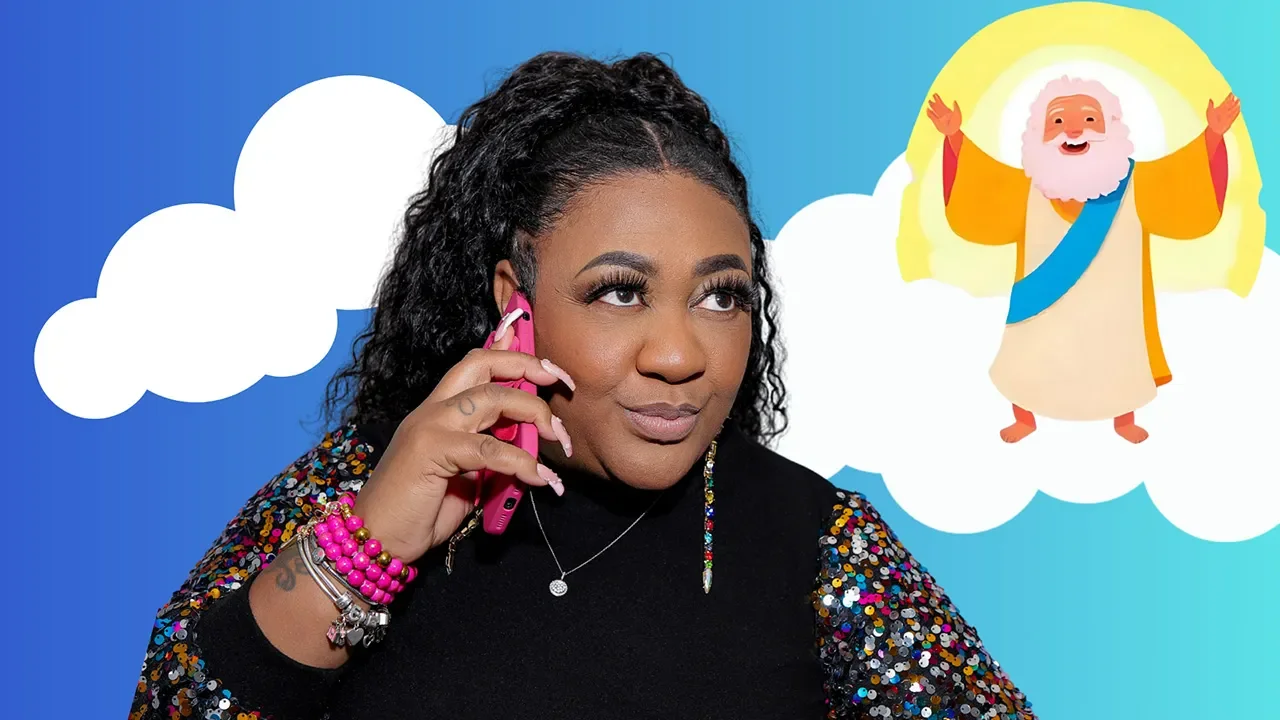
As published on salvationsouth.com
Erika Kellom was always a huge Prince fan. To her, the Minneapolis musical chameleon, whose hit records broke down all the barriers between funk, rock, pop, and R&B, was a role model. She loved his provocative style and unapologetic creativity.
“He wasn’t trying to be anybody else but Prince,” she says.
She says Prince’s “out-of-the-box approach” to music and flamboyant style inspired her to stay true to herself and embrace her own unconventional personality.
That’s why she felt as if she had lost a family member when her mom called her at work at the University of Alabama on April 21, 2016, to tell her Prince had died.
Auntee Pam Southern comedy | Erika Kellom plus size fashion | Facebook viral calls to heaven
“Purple Rain Prince?” she asked her mother in shocked disbelief when she heard the unexpected news.
Kellom still isn’t sure what moved her to do what she did next, which was to go into an empty office and record a video of herself making a nine-minute phone call to heaven to “inquire about Prince’s final arrangements.”
“I was made aware that he had been cremated, and I want to call heaven to confirm that information...,” she tells the camera plaintively. “I just have some questions, so I’m going to make this phone call. Please bear with me.”
“I was made aware that he had been cremated, and I want to call heaven to confirm that information...,” she tells the camera plaintively. “I just have some questions, so I’m going to make this phone call. Please bear with me.”
She punches a number into a desk phone and waits for an answer. When it comes, she says, “Hello. Is Jesus’s secretary available?” As the call continues, she asks Christ’s secretary to verify that Prince’s body had been cremated—not just any old Prince, but “the ‘When Doves Cry’ Prince...the Prince Rogers Nelson Prince.” Frustrated with Jesus’s secretary, she asks to speak to the Woman at the Well, who assures her Prince was fine with being cremated because he used hair relaxers and therefore had to know what fire felt like.
Then she posted the video to Facebook and to X’s now-defunct stream platform Periscope and titled it, “It had to be confirmed!!!!!!! #directlinetoheaven.”
On that day, one bright star passed away, but another was born: a character named Auntee Pam, who has over the last decade attracted more than a quarter-million followers each to Erika Kellom’s Facebook and TikTok accounts, plus another 150,000 on Instagram.
After that first post went viral, Kellom made calls to heaven to inquire about Betty White and Queen Elizabeth when they died.
“It just kind of became a thing,” Kellom says. Soon, people flooded Kellom's inboxes with messages anytime a famous person died, asking if she had heard about the latest celebrity death and whether she would call and check on them.
As she continued to call heaven, Kellom eventually created “Auntee Pam,” a churchgoing, sassy, no-nonsense character who did the dialing. Auntee Pam's unscripted calls feel real and relatable. She hopes her viewers find laughs, inspiration, and encouragement in Auntee Pam’s heavenly telecommunications.
Assembled around Auntee Pam is a cast of fictional characters Kellom has based on bits and pieces of people she knows in real life. Rashad, her cousin Janice’s eight-year-old grandson, lives with Auntee Pam because his mother has five children and Rashad is struggling in school. Auntee Pam steps in, pulls him out of public school, and places him in a private school.
“I’m just trying to take a kid who’s been in a situation where there’s no dad in the house, which is more often than not the situation in African American families, and paint a picture of the real things that happen from an African American perspective,” Kellom says, just as she has done in her own life with her eight-year-old goddaughter, who now lives with her.
Another important character is the fashionable widow Aunt Fannie, an older version of Kellom, who also lives with Auntee Pam because Aunt Fannie’s “bougie” daughter, married to a white man, lives in New York and hates the South. Aunt Fannie recently married Deacon Johnson, a sharp dresser in his colorful suits and polka-dot ties, who sings at church, having put aside a dream of being in the Temptations. Deacon Johnson enjoys cruises and casinos.
Today, Auntee Pam has called heaven more times than she can count. Some people are so taken with the authenticity of Kellom’s ensemble of familiar Southern characters that they send her heartfelt messages, hoping she will connect with their loved ones—as if she’s a medium.
But Kellom is far more than a social media darling—she’s an actress, singer, style maven, entrepreneur, business coach, and comedienne who runs an online plus-size boutique, EPK Chic, which she started at her kitchen table after receiving so many compliments on her own style. Her mission is to give plus size women more fashion choices. EPK Chic doesn’t sell muumuus.
Kellom’s all-consuming creativity might have blossomed from her strictly controlled childhood. Both Kellom’s parents were seventeen when she was born. Until she was in the fourth grade, she was raised by her two grandmothers. When she moved in with her mother, she also lived with her stepfather’s mother, Miss Ethel, who was from the country and knew her recipes by heart. Kellom swears she never ate macaroni and cheese from a box or a cake made from cake mix. Miss Ethel cooked every meal from scratch.
“A lot of people follow me who are widows, who are by themselves, or who have lost a mom or a grandmom,” Kellom says. “Something about the way that I talk, or something about the way that I say something, is calming to them.
As a young girl, when she complained about people or situations, her strict maternal grandmother, Laura Oden, had a straightforward message: “Erika, you just do right.” She jokes that her grandmother Oden, who attended a “fire and brimstone” Pentecostal church where women weren’t allowed to wear pants, makeup or earrings, didn’t let her go outside—for fear of her getting pregnant.
“She was overprotective because she didn’t want me to repeat the same thing my mother did,” Kellom says. Confined to home, church, and school, Kellom missed out on learning things other kids did. “I cannot skate, I cannot swim, I cannot ride a bike,” she says. But she can cook and she’s crafty. Over the Christmas holidays, she often films videos in her garage, surrounded by reams of ribbons and DIY accessories, as she makes wreaths and other elaborate Christmas décor for her customers.
Kellom describes her paternal grandmother, Naomi Daniel, a math whiz and chemist, as a “prissy” woman who often corrected other people’s grammar and manners.
“So, if we ate with the wrong fork or the wrong spoon, her word was ‘nonstandard,’” Kellom says. “She would just look at us and say, ‘nonstandard,’ if you used incorrect English or wiggled around at church.” Her grandmother Daniel, who attended 45th Street Baptist Church in Birmingham and wore a short, white choir robe she ironed every Saturday before church, was more relaxed but “was as Baptist as they come,” Kellom says.
Kellom spent time with both grandmothers at their churches, and she loved the people-watching during services. At home, she stood in front of the mirror and created characters based on people she saw in church. “I would imitate how Miss So-and-So sang, and how the preacher preached.” She created a theater in her own room and preached to her dolls. Throughout high school, she played in the band and sang in the choir, earning a scholarship to Stillman College, a historically black Presbyterian college in Tuscaloosa, Alabama.
During college, a friend encouraged her to audition at Red Mountain Theater, a nonprofit theater in Birmingham, where she played a role in the musical Shout that was originally written for a white British woman. Kellom has worked in local theater, playing the fierce Sofia in The Color Purple and Calpurnia, the Finch family’s cook and a mother figure to Scout, in To Kill a Mockingbird. She has also performed musical tributes to Gladys Knight and Aretha Franklin in Birmingham and Atlanta.
On social media today, Kellom’s cast is always growing. Recent additions include Brother Burwell, who wants to date Auntee Pam. She is too independent to be interested in him. Then, from Auntee Pam’s church, there is Pastor Bryant; Mrs. Price, who always gets on Auntee Pam’s nerves; and Cousin Pearl, an expert at cooking collard greens.
Kellom has fashioned Auntee Pam’s sister, who’s simply called “Sister,” after her maternal grandmother’s sister, who talked on the phone with her grandmother daily. Sister is timid, naïve, and lets people take advantage of her. Most recently, Auntee Pam scolded Sister for spending all her money at the casino on the day before The Rapture.
When Auntee Pam isn’t talking to Sister, she calls heaven and asks to speak to a Biblical character. She recently asked to speak to Tamar, and her followers thought she meant the famous actress Tamar Braxton, not realizing Auntee Pam meant Tamar the daughter-in-law of Judah in the thirty-eighth chapter of Genesis.
“One lady commented, ‘I didn't know Tamar Braxton had twins.’ And I said, ‘Go read your Bible.’”
“Whenever I run out of content, I always just pick any scripture out and call heaven to get clarity on that scripture.” Like the bit in the Sermon on the Mount when Jesus instructs his listeners that, when slapped, they should turn the other cheek.
“And I'm like, ‘Okay, I only have two cheeks, so how many times do you want me to turn?’” Kellom says, laughing. “I'll just take a scripture and take it literally and call heaven.”
Kellom loosely based Trisha, her one white character, on a former coworker. “I have to do more with Trisha during Easter because the Easter experience for African Americans and Caucasians is different,” Kellom says. “You know what I’m saying? The Strasbourg outfits with the embroidery and the knee socks?” When Kellom dressed her young children this way, she was accused of trying to be white, but that’s how she was dressed by the women who raised her.
“Trisha always comes out at Easter,” Kellom says. “She always comes out at the Fourth of July, because the truth of the matter is, different races celebrate holidays differently. That’s just the truth.”
But Auntee Pam reaches followers of different ages, races, and backgrounds. Many times, when she posts videos about things “black folks say,” white women respond by saying, “We say that, too!”
“Even if the outside is different, on the inside, we’re just people. We may experience life differently, but at the end of the day, we’re more alike than different,” Kellom says.
After almost a decade of spreading Auntee Pam’s gospel of laughter, Kellom’s days have become tremendously full. When she is not filming unscripted scenarios for her characters, she is running a clothing company, coaching aspiring entrepreneurs, or preparing for different events. She envisions staging a one-woman show as Auntee Pam, a show that would lift spirits and create bridges among audience members, despite differences in age, race, or socioeconomic backgrounds. She’ll even admit to a dream of becoming a household name, a la Eddie Murphy or Richard Pryor.
But until then, Kellom feels she has everything she needs to fulfill her dreams here in Birmingham. She has even written a play that will be staged at the Children’s Dance Foundation in Homewood, Alabama, February 20 through 26 next year.
Kellom believes making people laugh has a higher purpose. She notes that seeking treatment for mental health challenges is a taboo subject in too many Black communities.
“Back in the day, it was an uncle, or somebody locked in the basement,” she says. Today, there’s less shame surrounding mental health issues, and she sees laughter as one way to ease her audience’s burdens, even if just for a moment. Nothing pleases Kellom more than hearing a fan tell her they’d been feeling down, but after watching her video felt hopeful again.
“I want Auntee Pam to be an advocate for or a solution for people who deal with depression, people who are anxious,” she says. “I really think that Auntee Pam is unique, not just because it’s me but also because she’s such a unique character, a unique person that can really bring healing in a lot of different areas.”
Not everyone understands her humor, Kellom knows. A fair number of people—“miserable Marthas”—even call her blasphemous for placing phone calls to heaven.
But over the past decade, like her idol Prince, she stayed true to her creative vision—and to her personal motto: “Just laugh,” she says. “It will lighten the load.”